
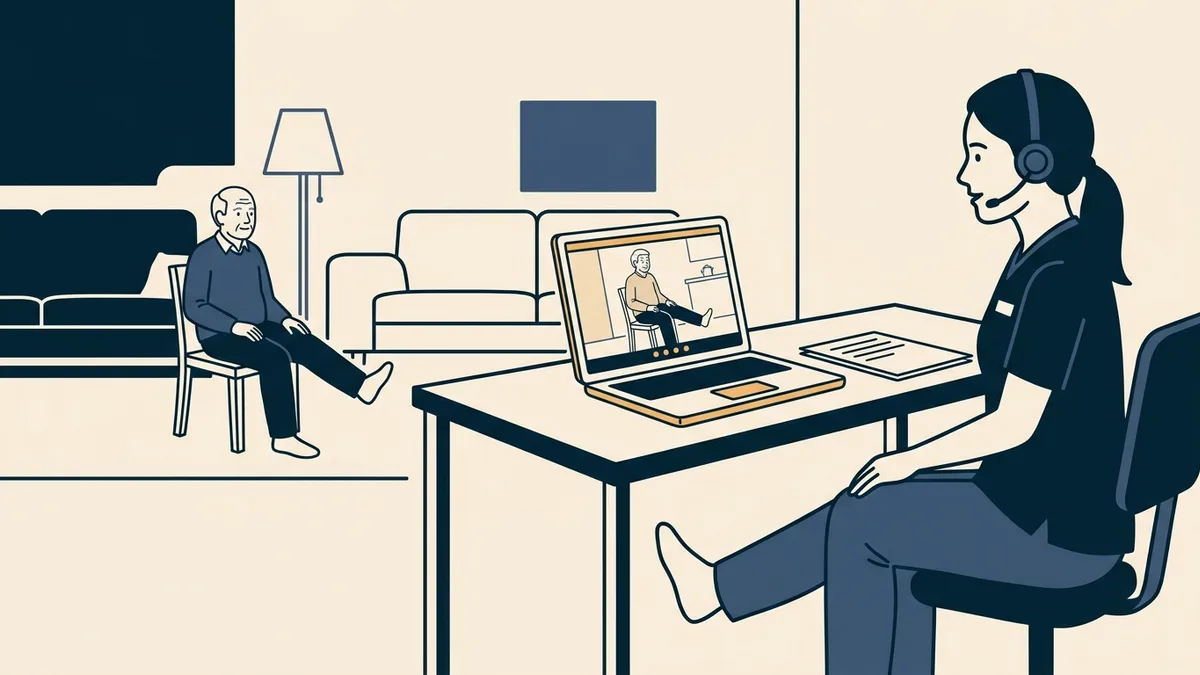
For telehealth physical therapy, the state where the patient is physically located during the session governs. You need a license or compact privilege in that state, and its practice act applies. Your own location and the company's location do not change that, so confirm the patient's location at every visit.
Telehealth lets a physical therapist in one state run a session with a patient in another without either of them traveling. The licensing rule does not bend to that convenience. The state that governs is the one where the patient is physically located during the session, and your authority to practice has to cover that state.
Your location does not decide it
A therapist working from home in an issuing member state, treating a patient who is sitting in a neighboring state, is practicing in the neighboring state. The therapist needs a license or a compact privilege there. The same holds if the clinic is in your state and the patient logs in from a vacation rental, a college dorm or a relative's house across the line. The practice act that applies, including its rules on supervision, documentation, direct access and the use of assistants, is the one in the patient's state.
This catches clinicians who join a telehealth company assuming the company's state, or their own, is what counts. It is not.
How the compact fits
For a therapist whose home state is an actively issuing member, a privilege in each issuing state where patients will be located covers telehealth practice there. Eligibility is the ordinary test: an active, unencumbered home-state license, no disciplinary action and a passing NPTE. Each privilege carries the Commission fee, a state fee and, in some states, a jurisprudence exam.
For patients in states outside the compact, such as California, Florida and New York, or in Maine, Michigan and Rhode Island until they begin issuing, you need a license in that state by endorsement. A privilege cannot reach those patients.
PTAs delivering care by telehealth work under the same patient-location rule, and the supervision requirements of the patient's state apply to that arrangement.
Build the schedule around location
The practical safeguard is to confirm the patient's location at every visit, not only at intake. Patients travel. A patient screened as local in March may join from another state in July. Record the location in the note. If the patient is somewhere you are not authorized, reschedule rather than treat.
If you are building or joining a telehealth caseload, look at where your patients actually are before applying for anything. A few privileges often cover most of a regional practice. Chasing every state produces renewals without patients.
Questions to put to a telehealth employer
Ask which states the company expects you to cover and who applies for and tracks those credentials. Ask how the scheduling system records patient location and what happens when a patient is outside your states. Ask whether the plans the company bills cover telehealth physical therapy in those states, since authorization to practice and reimbursement are separate questions. And where a practice act's telehealth provisions are unclear, ask that state's board directly.
Common questions
- Do I need a license where I am or where the patient is for telehealth PT?
- Where the patient is physically located during the session. That state's practice act governs the visit, so you need a license or a compact privilege there regardless of where you or your employer are based.
- Does a compact privilege cover telehealth visits?
- Yes. A privilege in an issuing member state authorizes practice there, including telehealth, on the same eligibility terms as in-person care. It cannot reach patients in states outside the compact.
- What should I do if a patient logs in from another state?
- If you are not authorized in that state, do not treat. Reschedule the visit for when the patient is back in a state you cover, and record the location in the note.
- Is telehealth PT licensure the same question as telehealth reimbursement?
- No. Being authorized to practice in a state does not mean a given payer covers telehealth physical therapy there. Check payer policy separately from licensure.
Need Help with Your Application?
We handle the PT licensure process end-to-end — eligibility screening, documents, board follow-ups, and tracking.