
In a school in another state, a compact privilege or license authorizes you to practice physical therapy under that state's practice act. Education law, the state education agency and the district add separate requirements, which may include an education credential, evaluation timelines, program documentation and Medicaid billing rules. You need to meet both.
Physical therapists who work in schools answer to more than one rulebook. When a school-based PT or PTA takes a position in another state, perhaps through a staffing agency filling a district vacancy, a compact privilege may authorize them to practice there. It does not settle how practice in a school must work.
The privilege brings you under the remote state's physical therapy practice act. Education law and the state education agency add a second set of requirements that sits alongside it.
Two sets of rules at once
The practice act governs you as a physical therapist or assistant: scope, supervision, documentation and direct access conditions. The education side governs the service as part of a student's education program. Federal special education law frames school-based services across the country, but states implement it differently, and districts add their own policies.
Some states require school-based therapists to hold a credential, certificate or approval issued by the education agency, in addition to authorization to practice physical therapy. Others do not. Whether a compact privilege satisfies an education agency's requirement is a question for that agency, not the compact. Ask early, because an education credential can take longer to obtain than a privilege.
Education law shapes the work
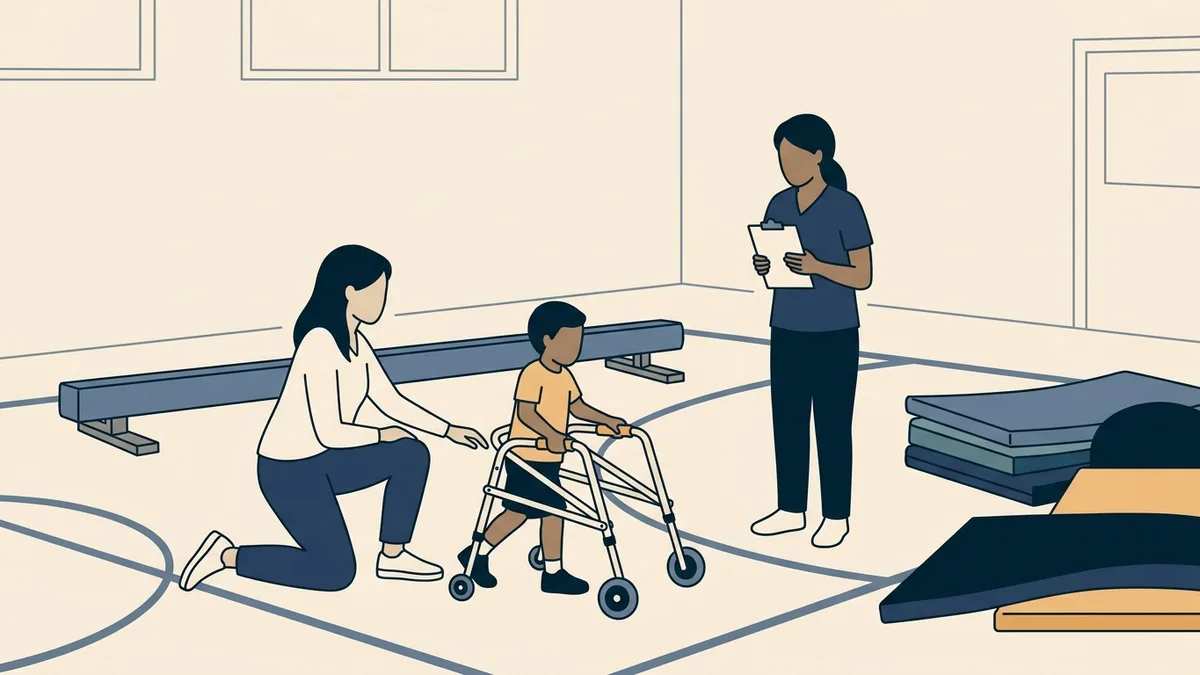
School-based physical therapy is tied to a student's educational needs rather than to a medical plan of care alone. Evaluations may need to follow state education timelines. Goals are written into an individualized education program or a similar plan, and services are delivered in ways that support the student's participation at school.
Documentation often has to satisfy both frameworks. The practice act may require certain elements in the therapy record, while the district requires progress reporting on its own forms and schedule. If the district bills Medicaid for school-based services, another set of documentation and physician-involvement requirements may apply. Referral rules can matter here too, because states differ on how school-based evaluation relates to their direct access provisions.
Supervision and staffing in schools
PTAs are common in schools, often traveling between buildings. The remote state's supervision provisions apply in schools as they do elsewhere, and some states set rules specific to school settings. A caseload spread across many campuses can make required PT contact hard to schedule, so check the requirements against the real itinerary rather than the district's staffing plan.
Delegation to classroom aides and teachers deserves a careful read as well. Training staff to carry out positioning or mobility routines is part of school practice, but the line between training staff and delegating a physical therapy intervention is drawn by state rules.
Questions for the district before you start
Ask whether the district or the education agency requires any credential beyond your license or privilege, and who is responsible for obtaining it. Ask which documentation system and forms you will use, whether services are billed to Medicaid, and who supervises the PTAs on the team. Then read the remote state's practice act with those answers in hand, and contact the board or the education agency where the two appear to conflict.
Common questions
- Is a compact privilege enough to work as a school-based PT in another state?
- It authorizes physical therapy practice there, but some states also require an education credential or approval from the education agency. Whether a privilege satisfies that requirement is a question for the agency, not the compact.
- Do supervision rules for PTAs apply in schools?
- Yes. The remote state's practice act applies in school settings, and some states add setting-specific rules. Check the required PT contact against the actual building itinerary.
- What documentation does a school-based PT keep?
- Often two sets: therapy records meeting the practice act and education program documentation on the district's forms and schedule. Medicaid billing for school services can add further requirements.
- Who should I ask about school credential requirements in a new state?
- Ask the hiring district first, then confirm with the state education agency. For practice act questions, contact the state physical therapy board.
Need Help with Your Application?
We handle the PT licensure process end-to-end — eligibility screening, documents, board follow-ups, and tracking.