
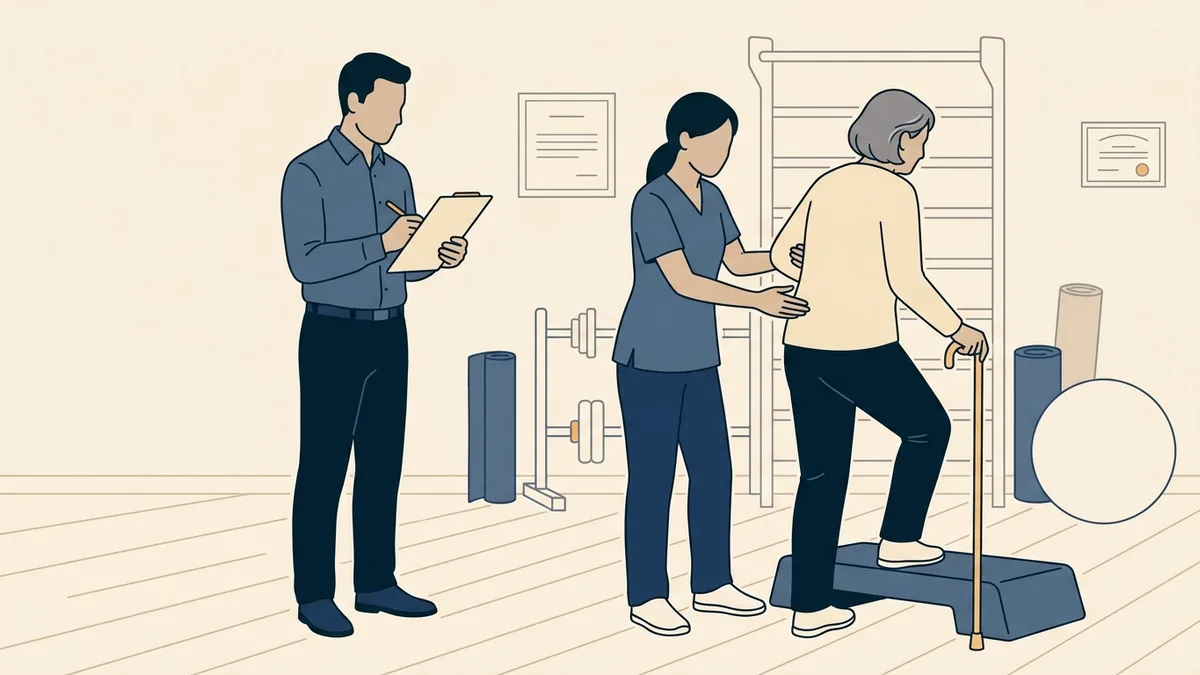
A supervising PT in a new state follows that state's practice act, not the home state's. Before a PTA treats, check how the state defines each supervision level and where it applies, any supervision ratio, when the PT must see patients personally, which tasks PTAs and aides may not perform, and cosignature rules.
When a physical therapist supervises a physical therapist assistant in a new state, the supervision rules that apply are the new state's. That is true whether the PT holds a compact privilege or a full license there, and it is true for the PTA as well. Both professions are covered by the compact, and both practice under the remote state's practice act once they begin treating patients located there.
Supervision is where that principle has its largest practical effect. The rules decide how a clinic is staffed, how a home health route is built, and how much of each patient's care the PT must deliver personally. A model that works well in one state can be out of compliance in the next with the same people doing the same work.
A privilege carries no supervision rules with it
A compact privilege answers whether you may practice in a state. It says nothing about how you must supervise there. Your home state's rules do not travel with you, and neither does the arrangement you and your assistants have used for years.
Responsibility tends to land on the supervising PT. Practice acts generally put the duty to provide adequate supervision on the physical therapist, and a PT who signs off on care delivered outside the state's rules shares the exposure even if a manager built the schedule. That is the reason to do this review yourself rather than rely on an employer's assurance.
Levels of supervision and how states define them
States generally describe supervision in levels. The names vary, and so do the definitions behind them. One state's general supervision may mean the PT is reachable by telecommunication. Another's may require the PT to be able to reach the site within a set time. On-site or direct supervision may require the PT to be in the building, or in the immediate treatment area, while the PTA treats.
States also vary the required level by setting. A rule for outpatient clinics may differ from one for home health, schools, skilled nursing or hospitals. Read the definitions section first, then find where each level is applied. Do not assume a familiar term means what it meant at home.
Ratios and caseload limits
Some states cap how many PTAs a single PT may supervise, and some count aides or other support personnel toward the same limit. Others set no fixed number and rely on the PT's judgment. Where a ratio exists, check how it is measured: at any moment, across a shift, or across every location the PT covers.
For a PT covering more than one site, or supervising both PTAs and aides, the arithmetic matters. A schedule that looked reasonable when it was built can exceed a limit on the busiest days of the week.
Patient contact the PT must make personally
Many states require the supervising PT to see the patient at defined points: the initial evaluation, periodic reassessments or joint visits, and discharge. The interval may be expressed as a number of visits, a number of days, or both, and it may differ by setting. Some states require the PT's involvement whenever the plan of care changes.
These provisions decide whether a PTA-heavy model is workable. If the PT must see each patient at short intervals, the PT's own schedule has to leave room for those visits.
Tasks a PTA may not perform
PTAs generally do not perform initial evaluations or establish the plan of care, but beyond that the lists diverge. Some states restrict PTAs from particular interventions, from progressing treatment beyond set parameters, or from working in certain settings without extra conditions. An intervention a PT may perform in a state may be off-limits to a PTA there.
Delegation to unlicensed aides is a separate set of rules, often stricter. Check what an aide may do, who must be present when they do it, and whether a PTA may direct an aide at all.
Documentation and cosignature
States differ on whether a PT must cosign PTA notes, how quickly, and what the PT's own notes must show. Some require a record of the supervisory contact itself, such as a note of the joint visit or the conversation between PT and PTA. Payers may add requirements of their own.
Electronic record templates are often built for one state and reused elsewhere. Confirm that the template captures what the remote state requires, and that cosignature actually happens within the required time rather than piling up in a queue.
Checks to complete before the first shift
Pull the practice act and board rules from the remote state's board. Read the definition of each supervision level, the settings each applies to, any ratio, the required PT contacts, the PTA and aide task limits, and the documentation duties. Write each one down in a sentence.
Then compare that list with the schedule you have been given. Ask the employer who will supervise each PTA, at which sites, and how the required PT visits will be scheduled. If the answers do not fit the rules, raise it before anyone treats a patient.
If a provision is ambiguous, ask the board in writing and keep its reply. A licensing attorney in that state can help with questions the board will not answer. This article describes the kinds of variation to look for, not any state's current requirements, and those requirements can change.
Common questions
- Do my home state's PTA supervision rules apply in a compact privilege state?
- No. Both PTs and PTAs practice under the practice act of the state where the patient is located. Supervision levels, ratios and PT visit requirements come from that state.
- Who is responsible if a schedule violates supervision rules?
- Practice acts generally place the duty of adequate supervision on the supervising physical therapist. A manager building the schedule does not remove that exposure, so review it yourself.
- Is general supervision defined the same way in every state?
- No. The same term can mean telecommunication availability in one state and a duty to reach the site within a set time in another. Read the definitions in the remote state's act and rules.
- How often must a supervising PT see a patient treated by a PTA?
- It depends on the state and often on the setting. Requirements may be expressed in visits, days or both, and may include reassessments, plan changes and discharge. Check the remote state's provisions.
- Does the PT Compact cover physical therapist assistants?
- Yes. PTAs obtain compact privileges under the same agreement as PTs, but the privilege does not import supervision rules from the home state.
Need Help with Your Application?
We handle the PT licensure process end-to-end — eligibility screening, documents, board follow-ups, and tracking.