
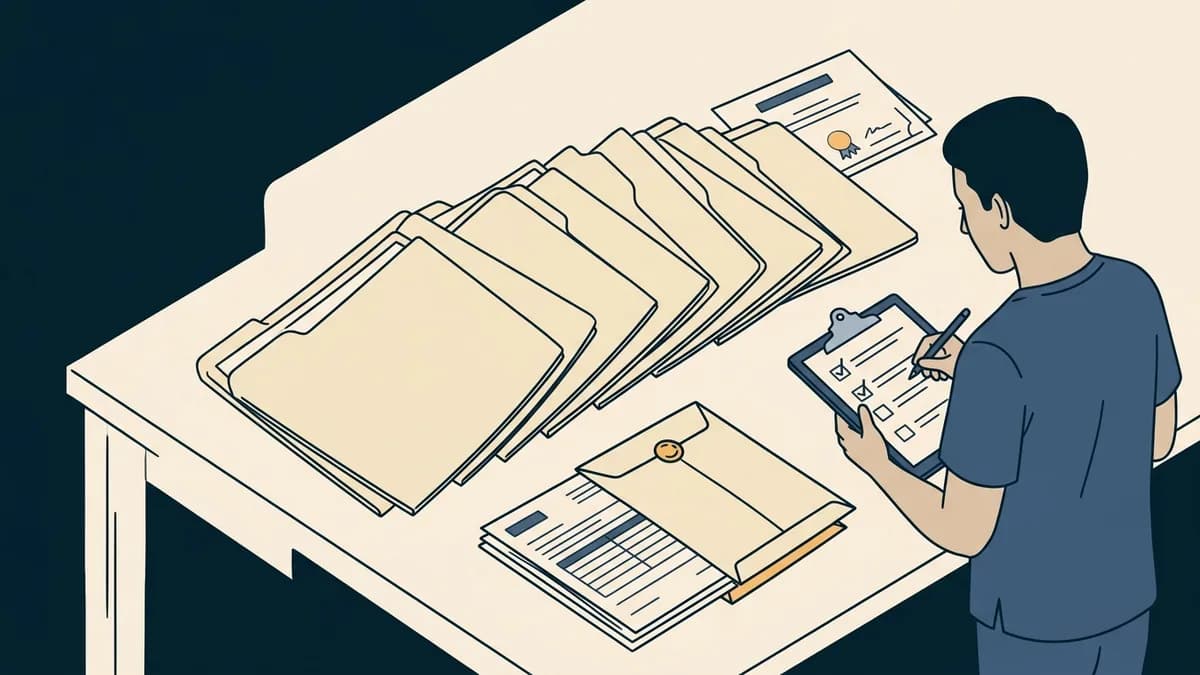
A typical PT state license application needs identity documents, education evidence, NPTE score transfer through FSBPT, verification of every license held, fingerprints for a background check, any state jurisprudence exam, and complete disclosure answers with supporting records. Requirements vary, so build the list from the board's current instructions.
Boards do not review applications piecemeal. Most wait until the file is complete, and a file is complete only when every required item has arrived through the channel the board specifies. That makes a license application less a form than a collection project. The list below is organized by category, with notes on the failure points in each. Treat it as a way to read your board's checklist carefully, not as a substitute for it.
Identity and name documents
Expect to provide your legal name, any prior names, date of birth, and a Social Security number or other identifier the board requires. Some boards ask for a government-issued photo ID or a passport-style photograph, occasionally notarized.
The trap here is consistency. Your application name should match your FSBPT record, your transcripts and your existing licenses, or you should be ready to show the documents that connect them. Gather marriage certificates, divorce decrees or court orders now if any of your records carry a different name.
Some applications also ask for address history, current contact details and an employment history covering your time in practice. Pull dates and employer names from old offer letters or tax records rather than memory, because the same history may later be compared against license verifications and credentialing files.
Education records
Boards need evidence that you graduated from an accredited physical therapist or physical therapist assistant program. Depending on the state, that might be an official transcript sent directly by the school, an education verification form completed by the program, or reliance on the education record tied to your original exam eligibility.
Official transcripts almost always have to come from the school, not from you. If your program has closed or merged, find out who holds its records before you need them. Internationally educated therapists face a separate credential evaluation process, which deserves its own plan and usually its own head start.
Examination
Your passing NPTE score is sent to the board through FSBPT's score transfer service, requested separately from the board application. Confirm you are requesting the right exam for your discipline and the right jurisdiction.
If the board has conditions about older scores or time out of practice, find them now. They may add requirements like proof of recent practice or continuing education.
PTAs follow the same logic with the PTA versions of each item: the PTA exam result, a PTA program transcript and PTA license verifications. A request that names the wrong discipline arrives, gets filed and still leaves the application incomplete.
Licenses held elsewhere
List every physical therapy license you have held, active, inactive, expired or surrendered, and arrange verification for each as the board requires. Some boards check other states' public lookups themselves. Others require official verification sent directly from each prior board, sometimes with a form and fee.
This is usually the slowest category, because it depends on as many outside offices as you have held licenses. Start it first. Keep a record of each state, license number and the date you requested verification.
Background and fingerprinting
Many boards require fingerprints for state and federal criminal background checks. The board's instructions set the vendor or card type, the agency code and the timing. Some require the application to be on file before prints are taken, and results may only be valid for a limited period.
Do not reuse prints taken for an employer or another state unless the board explicitly allows it. Results generally go only to the agency named on the request.
Fees belong on the list too. The application fee, the fingerprint processing fee, the score transfer and some verification requests are often paid separately, to different organizations. An unpaid item can hold a file just as a missing document does, so note each payment and its receipt.
State-specific items
This is the category that varies most. It can include a state jurisprudence exam, specific continuing education courses, attestations that you have read the practice act, a supervision or practice setting form, or questions about how and where you intend to practice. Some boards ask for proof of recent clinical practice for applicants returning after a gap.
Read the board's application instructions end to end for these, rather than skimming for the familiar items. They are the pieces an applicant working from a checklist written for another state is most likely to miss.
Disclosure answers and supporting records
Nearly every application includes questions about criminal history, prior discipline, malpractice claims, and conditions that might affect practice, with wording that differs by state. Answer each question as written. Where the answer is yes, attach the supporting documents: court dispositions, board orders, proof that conditions were completed, and a brief factual explanation.
A disclosed, documented matter is a review. An undisclosed matter discovered through a background check or license verification is a separate problem, and often a bigger one than the original event.
Before you submit, go through the board's own checklist line by line and mark each item as submitted by you, requested from a third party, or still to do. Keep copies of everything you send and confirmations of everything you request. When the deficiency notice arrives, and one often does, you will be able to answer it the same day.
Common questions
- Is there one national checklist for PT license applications?
- No. Each state board sets its own requirements. The categories are similar across states, but the specific forms, delivery methods and extra items differ, so use the board's current checklist as the final authority.
- Which items should I request first?
- Start with anything another organization must send: license verifications, NPTE score transfer and education records. Those run on other offices' timelines, while forms you complete yourself can be finished in an afternoon.
- Can I send official documents to the board myself?
- Sometimes. Many boards require verifications and score reports to arrive directly from the issuing source. Documents that pass through the applicant may be rejected, so check each item's delivery rules.
- How should I handle a document that uses a different name?
- Submit proof connecting the names, such as a marriage certificate, divorce decree or court order, and list all prior names on the application. Updating the name with the source, like FSBPT, before requesting documents prevents most mismatches.
- Do I need continuing education records for a new state license?
- Some boards ask for proof of recent practice or continuing education, particularly for applicants who have been out of practice. Check the board's instructions for any such requirement.
Need Help with Your Application?
We handle the PT licensure process end-to-end — eligibility screening, documents, board follow-ups, and tracking.