
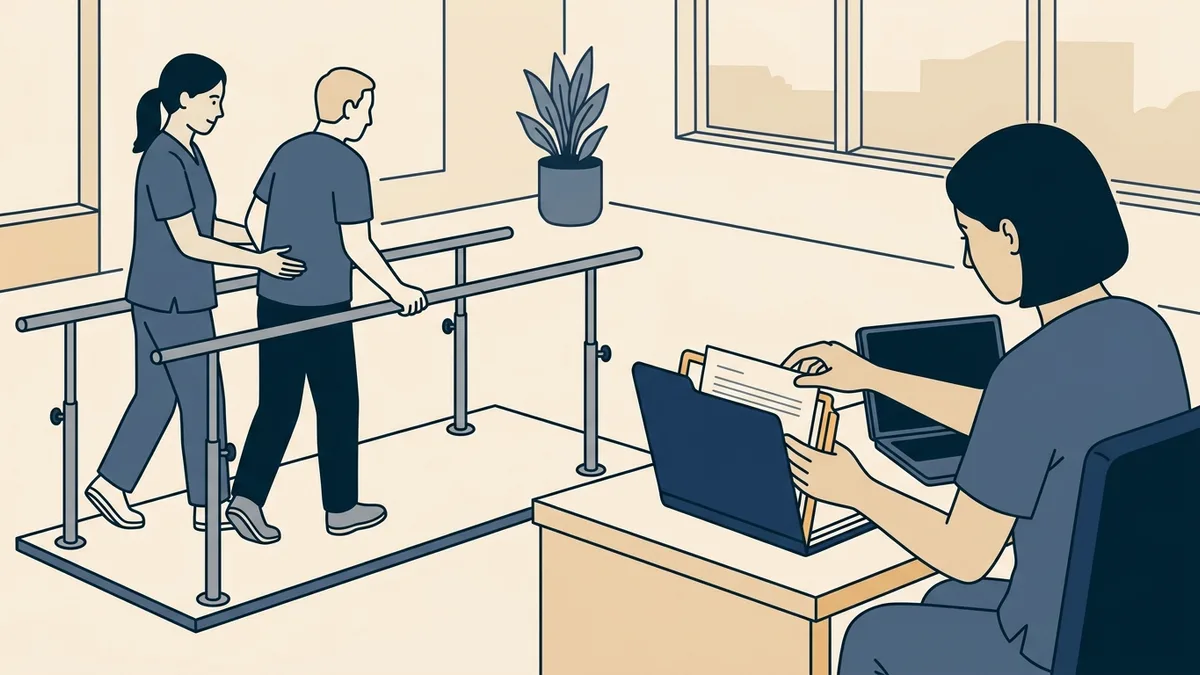
The PT Compact is an agreement among member states that lets a PT or PTA with an active, unencumbered home-state license buy a privilege to practice in other issuing states. A commission of member states runs it. A privilege is not a license: it depends entirely on the home-state license underneath it.
Physical therapy licensure has always been state by state. Each state writes its own practice act, runs its own board, and decides for itself who may treat patients inside its borders. For most of the profession's history that meant a therapist who wanted to work in three states held three licenses, filed three applications, and tracked three renewal cycles. The Physical Therapy Licensure Compact exists to shorten that path without taking authority away from any state.
A compact is a contract between states
An interstate compact is a law that each participating state passes in nearly identical form. Once enough states have enacted the same text, they are bound to one another by it, much as parties are bound by a contract. The PT Compact is one of these. A state joins by passing the compact statute through its legislature, and it stays in by keeping that statute on the books.
Passing the law is only the first half. A member state's board then has to connect to the commission's data system and meet the compact's operational requirements before it can issue or accept privileges. That is why the commission's list separates states that are actively issuing from states that have enacted the compact but are not issuing yet. As of the commission's list verified in September 2026, 38 jurisdictions are issuing and accepting privileges, three more (Maine, Michigan and Rhode Island) have enacted but are not issuing, and two (Illinois and Massachusetts) have legislation introduced only.
Governance sits with a commission
The compact creates the Physical Therapy Compact Commission, a public body whose members are the participating states. The commission writes the rules that govern privileges, runs the shared system that checks eligibility and records privileges, collects the commission's portion of each privilege fee, and maintains the official status list at ptcompact.org.
The commission does not replace state boards. Boards still license their own residents, investigate complaints, and discipline practitioners who work in their state, including those practicing there on a privilege. The commission is the connective layer that lets each board trust the others' licensing decisions.
Privilege versus license
This is the distinction that matters most, and the one most often blurred. A license is a credential a state issues to you after reviewing your education, exam results and background. You renew it, you build a record under it, and it stands on its own.
A compact privilege is an authorization to practice in a remote state on the strength of the license you already hold in your home state. It is issued per state, it is purchased rather than applied for in the full sense, and it depends entirely on the home-state license. If that license lapses or becomes encumbered, every privilege attached to it ends at the same time. A privilege also builds nothing toward a license in the remote state. Years of work on a privilege leave you exactly where you started if you later apply to that board for a license.
None of that makes privileges second-rate. For a defined period of work across a state line they are far quicker than the license route. They are simply a different instrument, and treating one as the other is where most compact mistakes begin.
Who qualifies
Every member state shares the same core eligibility conditions. You need an active, unencumbered license in your home state. That home state must itself be a compact member that is issuing. You must have no disciplinary action against any license you hold, and the commission applies a look-back window to that record. And you must have passed the NPTE for your discipline.
Home state means your state of primary residence, where you hold your primary license. It is not the state where your employer is based or where you happen to be working this quarter. A therapist who lives in Ohio and holds an Ohio license has Ohio as a home state; a therapist who lives in Florida cannot use a license from anywhere as a compact home state until they actually reside in a member state and license there.
Some remote states add their own conditions on top of the shared ones. The most common is a jurisprudence exam on the state's practice act, required in some states before an initial privilege and in some at renewal as well. The commission's fee and jurisprudence chart lists these by state.
Costs, in outline
Each privilege carries a flat $45 commission fee plus a fee set by the remote state, which varies from state to state. Because the state portion differs, the total for one state tells you nothing about the total for another. Budget per state, and read the current figure from the commission's chart on the day you apply.
Whose rules apply once you are treating patients
When you practice on a privilege, the practice act of the state where the patient is located governs the care. Scope, supervision ratios for PTAs, documentation requirements and direct access rules all come from that state, not from your home state. The privilege gets you through the door; the remote state's law tells you what you may do once inside.
Where to confirm any of this
The compact changes. States enact it, boards begin issuing, and fee and jurisprudence details are revised. The commission's own site is the reference for status, eligibility and fees, and the remote state's board is the reference for its practice act. A map on a blog, including this one, is a summary. Check the source before you sign a contract that depends on it.
Common questions
- What does the PT Compact actually let me do?
- It lets you practice in another issuing state on a privilege instead of applying there for a full license. You still hold one full license, in your home state, and each privilege is purchased separately for each remote state.
- Who runs the PT Compact?
- The Physical Therapy Compact Commission, a public body made up of the member states. It sets the rules for privileges, operates the system that checks eligibility, and publishes the current list of participating states at ptcompact.org.
- Are physical therapist assistants covered by the compact?
- Yes. PTs and PTAs are both covered. The eligibility conditions are the same, and a PTA's privilege is issued against the PTA's own home-state license.
- Can I use the compact if my license is from California?
- No. California is outside the compact, so a California license cannot serve as a home-state license for privileges, however long you have held it or however clean your record is.
Need Help with Your Application?
We handle the PT licensure process end-to-end — eligibility screening, documents, board follow-ups, and tracking.