
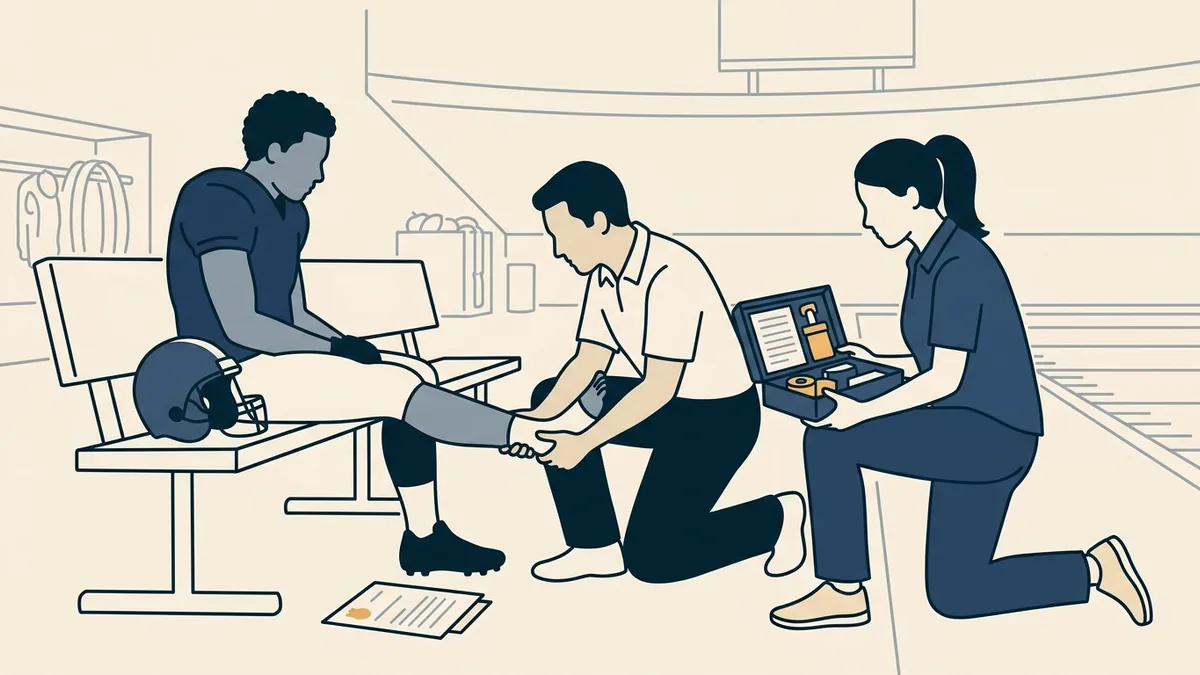
On an out-of-state sideline, a compact privilege authorizes a PT or PTA to practice physical therapy under the remote state's practice act, but it does not cover athletic training. Athletic trainers need whatever authorization that state requires, exemptions for visiting teams vary, and the boundary between the two professions is drawn by each state.
Sports medicine teams traveling to another state often bring physical therapists and athletic trainers who work side by side at home without friction. On a sideline in a different state, who may do what can look different, and the PT Compact answers only part of the question.
Two professions, two sets of laws
A compact privilege authorizes a physical therapist or PTA to practice physical therapy in the remote state under that state's practice act. It says nothing about athletic training. Athletic trainers are regulated separately under their own statutes, states regulate them in different ways, and the PT Compact does not cover them.
A clinician who holds both credentials should not assume a PT privilege covers athletic training work. Check whether the remote state requires its own authorization for athletic trainers, and whether it offers any exemption for visiting teams. Some states have exemptions limited by time or event; others do not, and the details vary.
Visiting-provider rules can differ for physical therapists too. Before relying on an exemption, confirm that it exists in the remote state's physical therapy law and fits your situation. Otherwise, a privilege or license is what authorizes you.
Where the overlap causes friction
Physical therapists and athletic trainers share skills: taping, bracing, therapeutic exercise, return-to-play progressions and injury assessment. State laws draw the line between the professions differently. An athletic trainer's scope may be tied to a defined population of athletes, may require physician direction or written protocols, or may exclude certain interventions. A physical therapist's may be shaped by that state's direct access conditions.
The practical risks are small ones that repeat. A PT treats an athlete who would need a referral under the remote state's direct access rules. An athletic trainer performs an intervention that falls outside athletic training in that state. A team physician's standing orders, written for home, get used unchanged on the road.
Emergency care on the field
Emergency response is where roles need to be clear before anyone runs onto the field. Decide in advance who leads spinal injury management, who handles concussion recognition and removal from play, and who talks to local emergency services. Many states have concussion laws specifying who may clear an athlete to return, and those laws may name particular professions.
Know how emergency services reach the venue and which facility receives transfers. Credentials help nobody if no one knows who is making the call.
Settling roles before the season
Before traveling, the team physician, physical therapists and athletic trainers should review the remote state's physical therapy and athletic training rules together, confirm each clinician's authorization, and adjust any protocol that assumes home-state scope. Write the agreed roles down and bring them. If an exemption or scope boundary is unclear, ask the relevant board in writing and keep the answer.
Common questions
- Does the PT Compact cover athletic trainers?
- No. The PT Compact covers physical therapists and physical therapist assistants. Athletic trainers are regulated under separate state laws, and the compact grants them nothing.
- Can a PT who is also an athletic trainer rely on a PT privilege for athletic training work?
- No. A PT privilege authorizes physical therapy only. Check whether the remote state requires its own athletic training authorization or offers an exemption for visiting teams.
- Are there exemptions for visiting team medical staff?
- Some states have exemptions for visiting clinicians, sometimes limited by time or event. They vary by state and profession, so confirm one exists and applies before relying on it.
- Who decides return to play after a concussion on an out-of-state sideline?
- State concussion laws often specify who may clear an athlete, and they differ. Check the law of the state where the game is played and agree on roles before the season.
Need Help with Your Application?
We handle the PT licensure process end-to-end — eligibility screening, documents, board follow-ups, and tracking.