
A home health visit is governed by the state where the patient's home is, so a therapist whose territory crosses a state line needs a license or compact privilege in each state visited. If both states issue privileges and your home state is one, a privilege is often simplest; otherwise the other state requires endorsement.
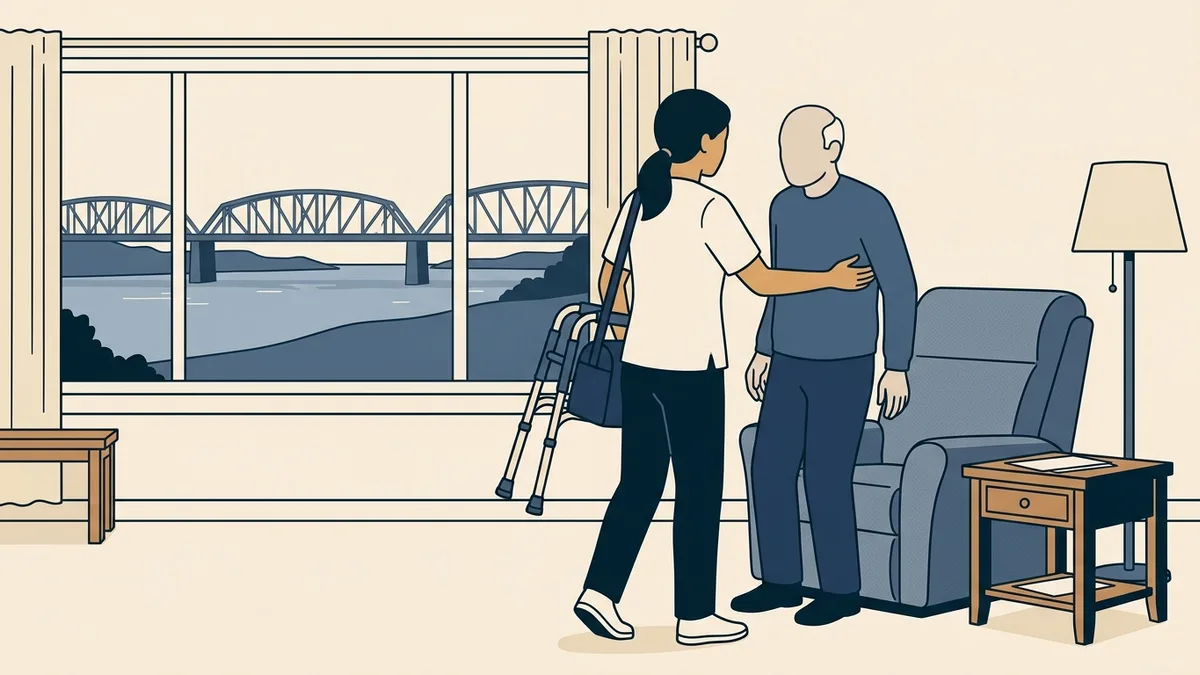
In many metro areas the state line is a bridge, a road or a river that patients cross without noticing. A home health agency based on one side may take referrals from hospitals on both, and its therapists drive a territory that spans two states, sometimes three. For the therapist, each visit is governed by the state where the patient's home sits.
One route, two practice acts
The licensure question is simple to state. A visit to a patient on the other side of the line is practice in that state, so you need a license or a compact privilege there. What follows from it takes more attention. The two states may differ on supervision of PTAs, on what a plan of care must contain, on documentation, and on direct access. A therapist who knows one state's act well can make a mistake across the line by doing exactly what is routine at home.
If both states are actively issuing compact members and your home state is one of them, a privilege in the neighboring state is usually the simplest answer. If the other state is outside the compact, or has enacted it without issuing yet, that side needs a license by endorsement. Check the status of both on ptcompact.org rather than assuming a neighbor matches your own state.
Scheduling is where the errors happen
Home health territories get reassigned. A coworker goes on leave and six visits across the line land on your week. An address looks local but falls on the far side of a boundary that runs down the middle of a street. A patient moves in with a daughter in the next state and the referral follows. None of these makes practicing without authorization the scheduler's problem. The board looks to the clinician.
Ask the agency how it matches visits to therapist credentials. Some agencies record which states each clinician can work in and block assignments that do not match. If yours does not, check each new address before the visit. For PTAs, confirm as well that the supervising PT is authorized in the patient's state and that the arrangement meets that state's supervision rules.
Keep the home license at the center
A privilege in the neighboring state depends on your home license staying active and unencumbered. If the home license lapses, the privilege ends with it, and half of your territory is gone the same day. Keep the home renewal date and the privilege renewal on one calendar, read the neighboring board's renewal terms rather than assuming they match home, and tell the agency's credentialing staff when each credential renews so their records stay current.
Agencies grow and routes shift. When a new county or town is added to your territory, check which state it is in before the first referral arrives.
Common questions
- Do I need a separate credential for home visits across the state line?
- Yes. A visit to a patient's home in another state is practice in that state. You need a license there or, if both states are issuing compact members and you are eligible, a compact privilege.
- Which practice act applies on a home visit in the neighboring state?
- The neighboring state's. Its rules on supervision, documentation, plans of care and direct access govern that visit, even if your agency is based on the other side of the line.
- Who is responsible if the scheduler assigns a visit in a state where I am not authorized?
- You are, as far as the board is concerned. Ask how the agency matches visits to credentials, and check new addresses yourself before seeing the patient.
- Can a PTA see patients across the line with a supervising PT?
- Only if the PTA is authorized in the patient's state and the supervision arrangement meets that state's rules, which can differ from the home state's.
Need Help with Your Application?
We handle the PT licensure process end-to-end — eligibility screening, documents, board follow-ups, and tracking.