
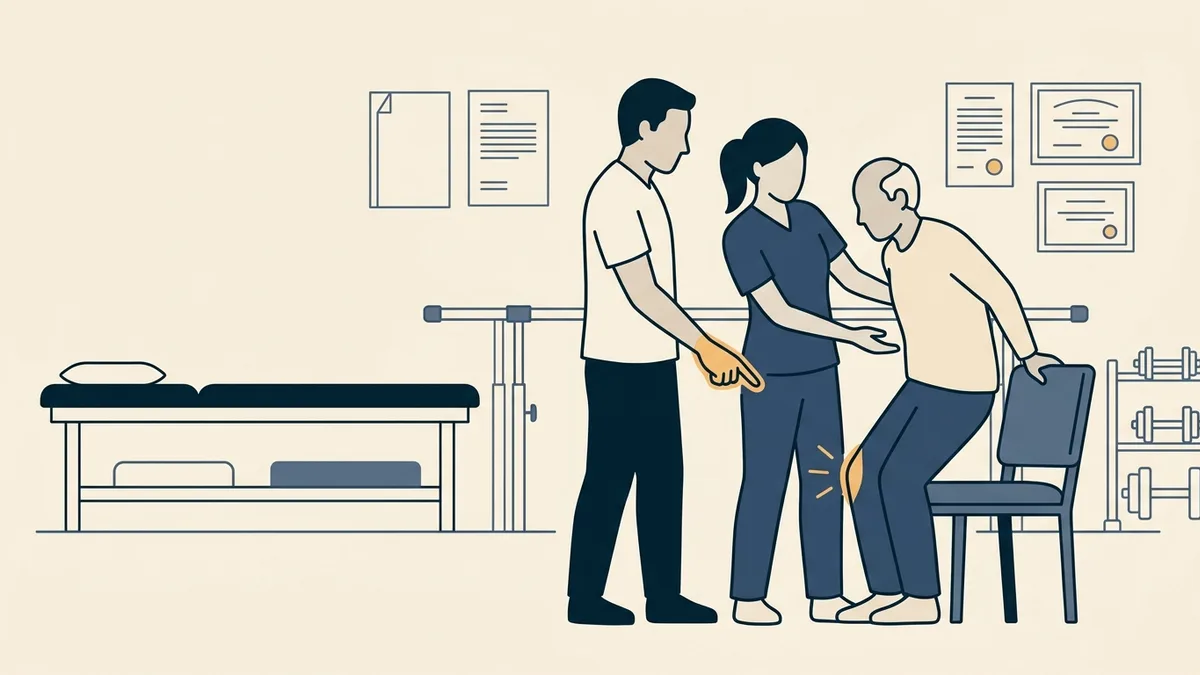
When PT students treat patients in another state, that state's practice act governs, and the licensed clinician supervising them needs a license or compact privilege there. Facility-employed clinical instructors are usually licensed where they work; the gaps appear with academic faculty supervising at out-of-state sites, pro bono clinics or telehealth visits.
Physical therapy education crosses state lines constantly. A program in one state places students in clinics across a region. A faculty member supervises a pro bono clinic across the river. A clinical instructor at a hospital near a border takes students from three schools. In each arrangement, the patient's location decides which state's practice act applies, and the licensed clinician responsible for the student's care has to be authorized in that state.
Supervisors carry the credential
Students provide care under the supervision of licensed clinicians, and what a student may do is set by the practice act of the state where the patient is. The supervising clinician's authority is not borrowed from the program. A faculty member licensed in the school's state who supervises students treating patients in another state needs a license or compact privilege in that state, the same as anyone else treating there.
For clinical instructors employed by the facility, this usually takes care of itself, since they are licensed where they work. The gaps appear with academic faculty who travel to sites, supervise in faculty practices or pro bono clinics outside the home state, or step in when a site's instructor is out.
Check the student rules in each state
Practice acts differ on what a student may do, what level of supervision is required, and how PTA students are supervised. Some address students directly; others speak only to supervision in general. A director of clinical education placing students in several states should know the rules at each site, and a faculty member supervising in person should read the host state's act before the first day. Where the text is unclear, the state board is the source.
Telehealth and remote supervision
Programs increasingly use telehealth for patient care experiences and for virtual check-ins with sites. When a student treats a patient by telehealth, the patient's physical location governs, and the supervising clinician needs authority in that state. Observing a student remotely during a site visit is a different activity from supervising care. If the observation turns into directing treatment, treat it as practice.
Where the compact helps faculty
Faculty whose home state is an actively issuing member can obtain privileges in the other issuing states where they supervise, subject to the usual eligibility rules and any jurisprudence exam. For sites in states outside the compact, including California, Florida and New York, or in Maine, Michigan and Rhode Island until they begin issuing, a license by endorsement is required. Programs placing students in those states should plan for it early, because faculty supervising there cannot rely on a privilege.
Clinical affiliation agreements often state which party verifies instructor credentials. Read that clause and make sure someone actually does the checking, for every site and every term.
Common questions
- Does faculty supervising students in another state need a license there?
- Yes, if they are supervising patient care. The patient's state governs, so faculty need a license or compact privilege in that state, the same as any clinician treating patients there.
- Which state's rules apply to what a PT student may do?
- The state where the patient is located. Practice acts differ on student activities and supervision levels, so read the host state's act or ask its board before the placement begins.
- Can faculty supervise students' telehealth visits from another state?
- Only with authority in the patient's state. When a student treats a patient by telehealth, the patient's physical location governs, and the supervising clinician needs a license or privilege there.
- Who verifies clinical instructor credentials for a placement?
- Clinical affiliation agreements often assign that task to the program or the site. Read the clause and make sure someone actually verifies credentials for every site and term.
Need Help with Your Application?
We handle the PT licensure process end-to-end — eligibility screening, documents, board follow-ups, and tracking.